
The History of the Chivito: Uruguay's National Sandwich
The History of the Chivito: The Accidental Birth of Uruguay's National Masterpiece
If you ask any Uruguayan to name the country's most iconic sandwich, the answer will be unanimous: the Chivito. It is a culinary titan, a vertical stack of flavors that defies the laws of physics and the limits of the human appetite. Yet, its name—which translates to "little goat"—is a linguistic riddle, as the sandwich contains absolutely no goat meat. Its origin is a fascinating tale of quick thinking, late-night hospitality, and a "midnight accident" that changed Uruguayan gastronomy forever.
The Night of the 'Mejillón' (1946)
The year was 1946, and the location was Punta del Este, the pearl of the Uruguayan coast. At the corner of Calle 31 and 20 sat "El Mejillón," a 24-hour restaurant owned by Antonio Carbonaro.
One fateful night, long after the primary kitchen staff had left, an Argentine tourist from the province of Córdoba arrived at the counter. She had been traveling all day and was longing for a taste of home: a roasted "chivito" (baby goat), which was a common specialty in the mountains of Córdoba.
Antonio Carbonaro faced a dilemma. He didn't have any goat meat in the building, and it was far too late to source any. However, he was a man committed to the satisfaction of his guests. Thinking quickly, he took a soft, round bun and grilled a thin, tenderized slice of beef tenderloin (churrasco). He topped it with a slice of ham, some melted cheese, and fresh lettuce and tomato. He told the customer, "I don't have goat, but I have a 'Chivito' made our way."
The tourist was so impressed that she returned the next day, and news of the "Chivito de Carbonaro" spread like wildfire. Within weeks, El Mejillón was selling over 1,000 sandwiches a day, and a national legend was born.
Anatomy of an Epic: The 'Chivito Canadiense'
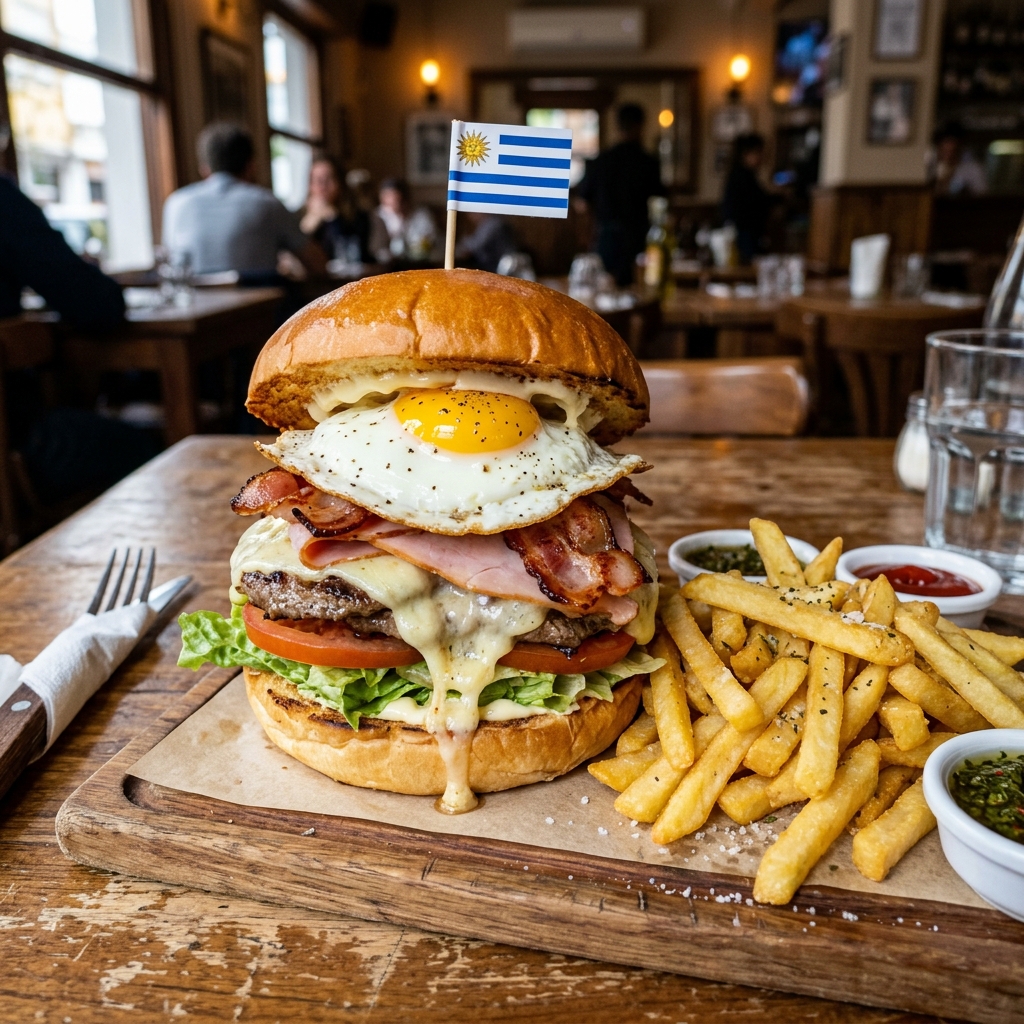
Over the decades, the Chivito has evolved from that simple steak sandwich into an architectural marvel. While there are several versions, the most famous is the Chivito Canadiense. Paradoxically named (it has nothing to do with Canada), this version represents the pinnacle of the sandwich's evolution.
To build an authentic Chivito, you must follow a specific layering logic:
- The Base: A soft, toasted bun, usually a brioche-style or a "pan de viena" that can absorb the juices without falling apart.
- The Heart: A thinly sliced, high-quality beef steak. At La Gran Uruguaya, we use premium lomo (tenderloin) or sirloin, tenderized until it can be cut with a fork.
- The Layers of Indulgence: On top of the steak goes a slice of high-quality ham, followed by crispy bacon (panceta).
- The Melt: A generous layer of mozzarella cheese, melted until it binds the ingredients together.
- The Egg: The crowning glory—a fried egg (usually "a caballo" or sunny side up) or sliced hard-boiled eggs.
- The Crunch and Acid: Crisp lettuce, fresh tomato slices, green olives (never black!), and often "morrones" (roasted red peppers).
- The Garnish: A generous spread of mayonnaise, often infused with garlic or herbs.
The 'Al Plato' Alternative
For those who find the verticality of the sandwich too intimidating to handle with their hands, Uruguayans created the Chivito al Plato. This version strips away the bread and arranges the ingredients as a massive feast on a large platter.
The steak, ham, cheese, and egg are laid out like a landscape, surrounded by a mountain of golden French fries (papas fritas). Often, this is accompanied by an ensalada rusa (Russian salad)—a mixture of potatoes, carrots, and peas in mayonnaise. It is a meal designed for sharing, though many brave Uruguayans take it on as a solo challenge.
A Cultural Masterpiece: Why It Matters
The Chivito is more than just "fast food." In Uruguay, it is a symbol of egalitarianism. You will see businessmen in suits and construction workers in vests sitting side-by-side at a counter, both tackling the same messy, glorious sandwich.
It also represents the quality of Uruguayan agriculture. Because the cattle are grass-fed and roam freely, the beef in a chivito has a depth of flavor that doesn't need heavy seasoning. The natural juices of the meat, combined with the melted cheese and the yolk of the egg, create a "sauce" that no industrial condiment can replicate.
The Bourdain Endorsement
The late, great Anthony Bourdain once visited Montevideo and was served a Chivito at a local institution. Watching a sandwich being built with such precision and scale, he famously called it "a beautiful thing" and "one of the best sandwiches in the world." He noted that while it seemed excessive on paper, the balance of protein, fat, and freshness in every bite made it perfectly coherent.
Bringing the Tradition to Queens
At La Gran Uruguaya, we understand that we aren't just selling food; we are protecting a legacy. Our Chivitos are made with the same spirit of generosity that Antonio Carbonaro showed that tourist in 1946. We use the highest-grade beef, fresh-baked bread, and we never skimp on the portions.
When you order a Chivito at our restaurant, we recommend coming hungry. Whether you choose the portable version or the "Al Plato" feast, you are tasting the heart of Uruguayan culture—bold, high-quality, and deeply welcoming. It is the ultimate expression of the Uruguayan palate, and we are proud to serve it exactly as it was meant to be.