
Dulce de Leche: The Liquid Gold of the Southern Cone
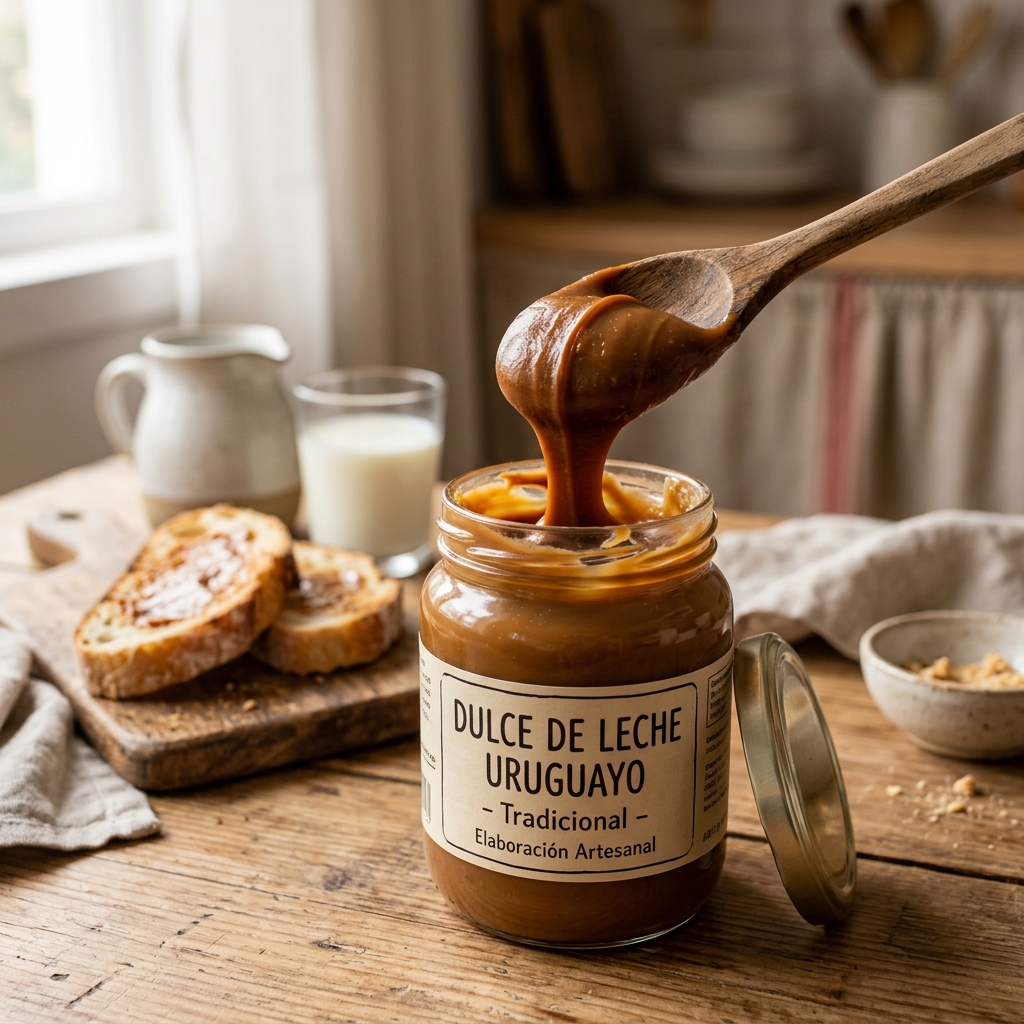
Dulce de Leche: The Liquid Gold of the Southern Cone
If Uruguay had a national currency based on flavor, it would be Dulce de Leche. It is more than a spread; it is a cultural cornerstone, a nostalgic touchstone, and a source of fierce national pride. In Uruguay, you don't just "like" dulce de leche; you belong to it.
The Alchemy of Simplicity
At its most basic, Dulce de Leche is made of only two things: milk and sugar. However, transforming these two into the thick, mahogany-colored silk we love is an exercise in extreme patience.
The process is called the Maillard reaction. By slowly simmering the milk and sugar at a low temperature for several hours, the sugars caramelize and the proteins in the milk undergo a chemical transformation. The result is a depth of flavor that a simple caramel syrup could never achieve—notes of toffee, vanilla, and cultured cream with a texture as smooth as velvet.
The Great Rivalry
There is an ongoing, friendly (and sometimes not-so-friendly) debate between Uruguay and Argentina over who "invented" Dulce de Leche. While the legend often points to a forgetful maid in 1829 who left milk and sugar on a stove during a political meeting in Cañuelas, historians noted similar recipes in the Philippines and Europe much earlier.
However, for a Uruguayan, the origin is secondary to the quality. We take immense pride in the richness of our dairy. With more cows than people in our country, the quality of the raw milk is unparalleled, resulting in a dulce de leche that is denser, darker, and more "milky" than many of its global counterparts. Brands like Conaprole have become symbols of the nation, found in the suitcases of every Uruguayan traveling abroad.
'Familiar' vs. 'Repostero': Know Your Dulce
Not all Dulce de Leche is created equal. Depending on how you intend to use it, you need the right "type":
- Dulce de Leche Familiar: This is the "table" version. It is smooth, slightly translucent, and easy to spread. It is the soul of the "pan con dulce" (bread with dulce) that every Uruguayan child eats as a snack.
- Dulce de Leche Repostero (Confectionery): This is the heavyweight champion. It is thicker, darker, and contains stabilizers that allow it to hold its shape under heat. This is what we use to fill our Alfajores, create the veins in our Postre Chajá, and stuff our Margaritas.
The 'Lapeado' Test
Ask any Uruguayan how to tell if a Dulce de Leche is good, and they will tell you about the "spoon test" or lapeado. You take a spoonful and turn it upside down. If the dulce stays on the spoon, defying gravity with its thick, creamy grip, you have a winner. If it runs off like syrup, it isn't worth your time.
A Taste of Childhood
Dulce de leche is the flavor of Uruguayan childhood. It’s the spoonful stolen from the jar when mom isn't looking. It’s the sticky fingers after a birthday party. It’s the comfort of home when you are thousands of miles away.
At La Gran Uruguaya, we don't just use Dulce de Leche as an ingredient; we treat it as a sacred trust. Whether it’s drizzled over our flan, sandwiched in our cookies, or swirled into our cakes, we use only the most authentic, premium Uruguayan dulce de leche. We invite you to experience the "Sweet Gold"—the taste that defines a nation.